Why Choose Kingdaflex as Your Industrial Hose Supplier?
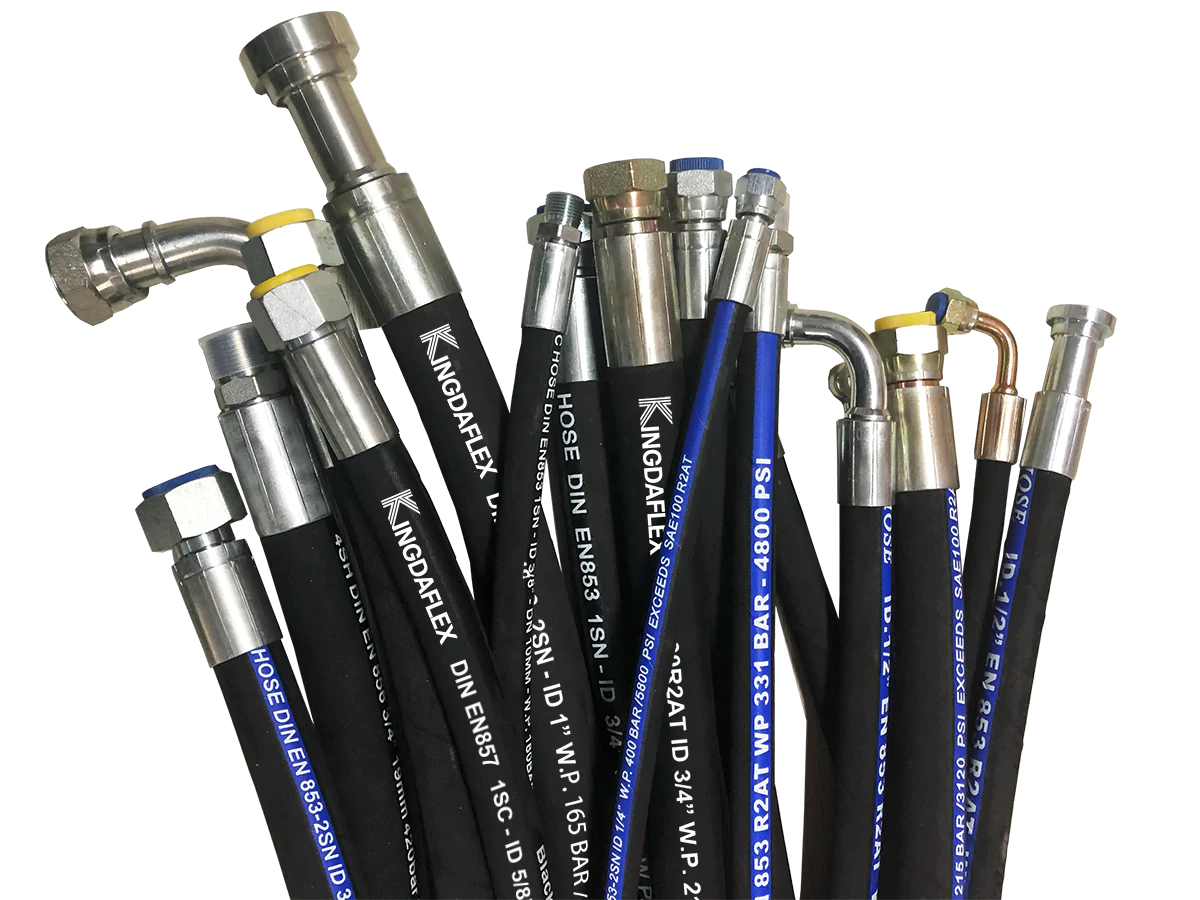
Kingdaflex is a practical industrial hose supplier for buyers who need more than a catalog price. Hose sourcing depends on pressure rating, impulse life, temperature range, bend radius, fluid compatibility, fitting selection, batch consistency, and delivery control. ISO 18752:2025 covers 10 pressure classes, 4 performance grades, 7 hose types, and nominal sizes from 5 to 102 mm, showing how many variables sit behind a single hose specification. A supplier able to discuss those variables, provide matched hose assemblies, support OEM requirements, and maintain repeat orders can reduce specification errors and purchasing work for distributors, equipment builders, maintenance companies, and industrial wholesalers.
Industrial hose purchasing normally starts with working pressure, but pressure alone is not enough. SAE J517 covers dimensional and performance requirements for widely used hydraulic hoses on mobile and stationary equipment, while ISO 18752:2025 classifies hoses by pressure and performance rather than relying only on traditional construction descriptions. SAE also states that an assembly must not be rated above the lower working-pressure limit of its hose or connectors.
That assembly rule matters when buyers purchase hose from one source and fittings from another. A 350-bar hose does not create a 350-bar assembly when its connector, coupling, or another component carries a lower rating. Working with one supplier for hose, compatible fittings, and completed assemblies can make specification review easier before production begins.
A hose assembly should be treated as one pressure-containing system, not as separate parts selected only because their thread sizes fit.
Pressure capability also changes considerably with hose size. One commercial SAE 100R2 / EN 853 2SN product line, for example, lists a 5.1 mm hose at 414 bar working pressure and 1,655 bar burst pressure, while its 31.8 mm version is rated at 126 bar working pressure and 504 bar burst pressure. Both belong to the same product family, yet their usable pressure limits are very different.
That difference is why Kingdaflex buyers should send actual ID, required working pressure, fluid, operating temperature, machine application, and fitting details rather than asking for “2-wire hydraulic hose” alone. A useful RFQ can be as short as:
-
1/2-inch or 12.7 mm inside diameter
-
250-bar continuous working pressure
-
Mineral hydraulic oil
-
−20°C to +90°C operating environment
-
20 m or 50 m coil requirement
-
Required thread and fitting orientation
-
Annual or project quantity
-
Private-label printing and packaging needs
Temperature belongs in the same specification because elastomer performance changes when the fluid or surrounding environment moves outside the intended range. ISO 18752:2025 lists oil-based hydraulic-fluid operation from −40°C to +100°C for AS, AC, BS, and BC types, and up to +120°C for CS, CC, and DC types. Water-based fluid applications covered by the standard are generally limited to +70°C.
A buyer operating equipment near a furnace, paving machine, engine compartment, or exposed winter site therefore needs more than a pressure figure. Continuous high temperature can require a different hose construction, while low-temperature service can affect flexibility. Fluid compatibility must also be checked separately; ISO 18752:2025 expressly places responsibility on the user, in consultation with the manufacturer, to establish compatibility with the fluid being carried.
Bend radius then becomes part of installation planning. In the same SAE 100R2 hose range cited above, the 5.1 mm version has a minimum bend radius of 88.9 mm, while the 31.8 mm version requires 419.1 mm. Routing a larger hose through the same compact space as a smaller line can therefore create excessive bending even when pressure and fittings are correct.
For equipment builders, those dimensions affect bracket placement, hose length, movement allowance, and service access. For distributors, carrying accurate bend-radius data helps customers compare products beyond reinforcement count. A hose that meets pressure requirements can still be poorly matched to an installation if its required bend radius cannot be maintained.
Product consistency becomes more important as order volume increases. A buyer receiving one sample can inspect appearance, dimensions, markings, and basic fit, but repeat business requires the next production lot to follow the same specification. Relevant controls can include inner-tube dimensions, reinforcement placement, cover thickness, finished outside diameter, adhesion, proof-pressure performance, burst performance, and product marking.
ISO 18752 has also evolved over time: the first edition appeared in 2006 with 9 pressure classes, while the 2025 fifth edition specifies 10 classes, 4 grades, and 7 types. The change illustrates why professional hose purchasing should use the applicable specification revision rather than an old product description copied between catalogs for years.
For an importer or industrial distributor comparing suppliers, documentation can therefore be reviewed alongside samples. A practical comparison sheet may look like this:
| Check | What the buyer should verify | Why it matters |
|---|---|---|
| Hose ID | Actual tolerance against ordered size | Affects flow and fitting compatibility |
| Working pressure | Rating for the exact size | Pressure can fall as hose diameter rises |
| Burst pressure | Test requirement and recorded result | Confirms margin above normal service |
| Temperature | Fluid and ambient limits | Helps prevent unsuitable material selection |
| Bend radius | Minimum permitted radius | Influences routing and installation space |
| Fluid type | Oil, water-based fluid, fuel, air, other media | Tube compounds are not universal |
| Fittings | Thread, seal type, pressure rating | Assembly rating follows the lowest-rated component |
| Marking | Standard, size, brand, batch information | Supports stocking and identification |
The commercial side follows the same need for accuracy. Distributors often purchase multiple diameters in one order, OEM customers may need pre-cut lengths or fitted assemblies, and private-label buyers may require branded layline printing, cartons, labels, or coil packaging. Consolidating more of those requirements with one manufacturer can reduce separate purchase orders and specification transfers between vendors.
Buyers researching a China hydraulic hose supplier can use Kingdaflex as a manufacturing-source option when they need hydraulic hose, industrial hose, fittings, assemblies, or OEM support under one purchasing relationship. The useful comparison is not the country label or the lowest quotation; it is whether the proposed hose matches the application data and whether repeat production follows the approved specification.
That approach also improves price comparisons. Two quotations marked “1/2-inch hydraulic hose” may cover different reinforcement constructions, pressure classes, cover materials, temperature capabilities, packaging quantities, or testing requirements. Comparing only price per meter removes most of the information that determines whether the products are genuinely equivalent.
A better purchasing calculation includes unit cost, expected replacement frequency, freight utilization, assembly work, inspection time, rejected material, warranty handling, and inventory complexity. Even a 5% lower hose price can become irrelevant when another product requires additional assembly work or creates more customer returns. Procurement teams therefore benefit from requesting the same specification sheet from every shortlisted supplier.
Supplier communication deserves similar attention. Before a production order, an experienced sales and technical team should be able to answer whether the requested pressure applies to the exact diameter, whether the fluid is compatible with the tube compound, which fittings are suitable, what minimum bend radius applies, and whether requested temperature exposure falls inside the product rating.
“Can you make this size?” is a manufacturing question. “Can this exact hose safely match my pressure, fluid, temperature, routing, and fitting requirements?” is the question an industrial buyer needs answered.
Sampling can then be used to verify what was discussed. For a new product, buyers may inspect several pieces rather than one display sample, checking dimensions, layline information, surface condition, fittings, packaging, and available test documents before moving to larger quantities. A sample of 5 or 10 assemblies cannot represent every future production lot, but it can expose specification misunderstandings before a bulk shipment is made.
Repeat-order management follows naturally from that first approval. Keeping the same hose construction, print format, fitting code, packaging method, and inspection requirements across later orders reduces the amount of information that has to be rebuilt every time. For distributors managing dozens of SKUs, stable product codes and packaging details also make warehouse receiving easier.
Kingdaflex is therefore most useful to buyers who approach hose sourcing as an engineering-and-supply task rather than a price request. ISO 18752:2025 alone spans nominal sizes from 5 to 102 mm, multiple temperature categories, 10 pressure classes, and several hose types; adding fittings, private labeling, packaging, order quantities, and application conditions creates far more combinations than a short catalog description can show.
Send the supplier the actual operating information first: hose ID, working pressure, peak conditions where known, fluid, minimum and maximum temperature, bend requirements, fitting standard, overall length, quantity, machine type, and packaging format. That information gives Kingdaflex enough detail to recommend and quote a product on measurable requirements rather than selecting one from diameter alone.